
Sold by: Plural
Deployed on AWS
Enterprise Kubernetes Management
5
Overview
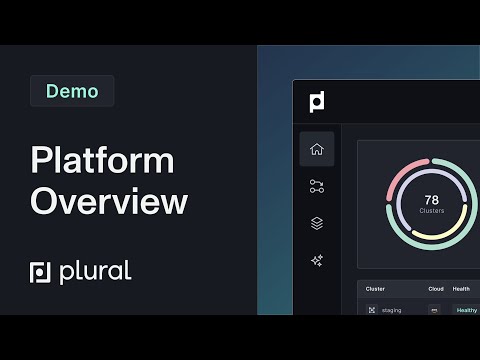
Plural is an AI-native Kubernetes management platform that enables engineering teams to scale large, complex environments and manage the entire Kubernetes development lifecycle.
Designed for security, scale, and flexibility, Plural is built on an agent-based pull architecture that never requires direct access to the clusters it deploys to. This means you can manage workloads in any cloud, on-premises, on the edge, or even on a local laptop running KIND, all from a single control plane.
With Plural, platform and DevOps teams gain multicluster visibility and control, simplified Kubernetes upgrades, enhanced compliance and security, and AI-powered automation for infrastructure workflows.
Key Benefits:
- Multicluster visibility and management - Operate fleets of clusters across AWS, Azure, GCP, on-prem, and edge environments.
- Agent-based pull architecture - Manage clusters securely without granting external access.
- Simplified upgrades and operations - Automate Kubernetes upgrades and day2 tasks with guided workflows.
- AI-powered automation - Leverage AI to accelerate infrastructure workflows and reduce manual toil.
- Enterprise security and compliance - Strengthen posture with built-in guardrails, policies, and auditable workflows.
- Single pane of glass - GitOps continuous deployment, IaC management, monitoring, self-service automation, and AIdriven insights in one platform.
Pricing is based on the number of clusters deployed and managed by Plural. Starting at 450/month for 1 cluster 250/month per additional cluster. For Plural cloud hosting and supports up to 10 clusters.
Note: Plural may incur standard AWS infrastructure charges (such as Amazon EKS) that are billed separately from AWS Marketplace subscription fees. Buyers are responsible for these AWS infrastructure charges in addition to any Plural subscription costs.
Highlights
- Scalability: Based on a scalable, secure, agent-based pull architecture. It doesn't require direct access to any of the clusters it deploys to, meaning it can manage workloads in any cloud, on-prem, or on the edge. Plural's GitOps-driven workflows enable repeatable and consistent operations of Kubernetes.
- Single Pane of Glass: Bring the entire lifecycle of Kubernetes under your control, from provisioning infrastructure, to upgrading clusters, to efficiently and repeatably deploying and managing services across your clusters.
- AI-Native: Plural's AI Assistant allows engineering teams to unify and automate both routine and complex infrastructure workflows. Plural provides AI insights and troubleshooting, the ability to query and understand your infrastructure with natural language, powerful agentic platform workflows, and cost analysis and intelligent right-sizing.
Details
Sold by
Delivery method
Deployed on AWS
New
Introducing multi-product solutions
You can now purchase comprehensive solutions tailored to use cases and industries.

Features and programs
Financing for AWS Marketplace purchases
AWS Marketplace now accepts line of credit payments through the PNC Vendor Finance program. This program is available to select AWS customers in the US, excluding NV, NC, ND, TN, & VT.

Pricing
Pricing is based on the duration and terms of your contract with the vendor. This entitles you to a specified quantity of use for the contract duration. If you choose not to renew or replace your contract before it ends, access to these entitlements will expire.
Additional AWS infrastructure costs may apply. Use the AWS Pricing Calculator to estimate your infrastructure costs.
Dimension | Description | Cost/12 months |
|---|---|---|
Management Cluster | Plural Management Cluster (1): A single management plane that will oversee the core responsibilities of fleet management. | $5,400.00 |
Workload Cluster | Plural Workload Cluster (1): Additional clusters you provision to run development and production workloads for your enterprise. | $3,000.00 |
Dimensions summary
Pricing scales by the number of clusters you run. You buy two separate unit types. The Plural Management Cluster is a single control plane that oversees fleet management. Workload Clusters are the extra clusters you add to run development and production workloads. You pay per unit of each type, so your cost grows as you provision more clusters. This lets you match spend to the size of your cluster estate. Both dimensions bill under a contract commitment.
Top-of-mind questions for buyers
Each unit maps to one Kubernetes cluster. The Management Cluster is a single control plane that oversees fleet management. Each Workload Cluster is one additional cluster you provision to run development or production workloads. You count units by how many clusters of each type you deploy.
Both dimensions bill independently and add together. You pay for one Management Cluster as the control plane. You then add a charge for each Workload Cluster you provision. Workload Cluster count usually drives most of the cost, since you scale those with your estate.
Cost changes with the number of Workload Clusters you provision. Adding a cluster adds one Workload Cluster unit charge. Removing one reduces your count. The single Management Cluster charge stays fixed regardless of how many workload clusters you run.
www.plural.sh
Helpful?
Vendor refund policy
Contact our support team for refund information.

Legal
Vendor terms and conditions
Upon subscribing to this product, you must acknowledge and agree to the terms and conditions outlined in the vendor's End User License Agreement (EULA) .
Content disclaimer
Vendors are responsible for their product descriptions and other product content. AWS does not warrant that vendors' product descriptions or other product content are accurate, complete, reliable, current, or error-free.
Delivery details
Software as a Service (SaaS)
SaaS delivers cloud-based software applications directly to customers over the internet. You can access these applications through a subscription model. You will pay recurring monthly usage fees through your AWS bill, while AWS handles deployment and infrastructure management, ensuring scalability, reliability, and seamless integration with other AWS services.
Resources
Vendor resources
Support
Vendor support
Enterprise Support via Email, Slack, and more: support@plural.sh
AWS infrastructure support
AWS Support is a one-on-one, fast-response support channel that is staffed 24x7x365 with experienced and technical support engineers. The service helps customers of all sizes and technical abilities to successfully utilize the products and features provided by Amazon Web Services.
Similar products

For North America and regions outside EMEA, Red Hat Advanced Cluster Managment for Kubernetes enables manage your cluster lifecycle, deploy applications, govern configuration with policies and observe and troubleshoot issues in your environment.

SUSE Rancher for AWS is fully managed multi-cluster management and governance for Amazon EKS. Standardize EKS management across accounts and regions, cut Kubernetes costs, and troubleshoot with an AI SRE guide built on Amazon Bedrock. 30-day free trial.


For the EMEA region, Red Hat Advanced Cluster Management for Kubernetes enables manage your cluster lifecycle, deploy applications, govern configuration with policies and observe and troubleshoot issues in your environment.
Customer reviews
Apostol T.
Extremely valuable tool for teams that want to stay leans
Reviewed on Feb 16, 2023
Review provided by G2
What do you like best about the product?
Plural is a great way to start with Kubernetes for managing an OSS data stack. Makes provisioning of popular services like Airbyte, airflow & more very easy and, most importantly, cost efficient. This is without the additional overheads that typically come with Kubernetes, such as dedicated Ops hire.
The team are great and always helpful. We've put all our previously separated services into plural and have been able to scale for more advanced use-cases which wasn't possible before.
The team are great and always helpful. We've put all our previously separated services into plural and have been able to scale for more advanced use-cases which wasn't possible before.
What do you dislike about the product?
There's very little to dislike about Plural at the moment. Their console is in continuous development and allows for monitoring of crucial Kubernetes components but some of them are still not available such as volumes, service accounts etc but these don't impact day-to-day operations at all.
What problems is the product solving and how is that benefiting you?
Horizontal scaling for our data stack. Deploying airbyte into kubernetes and orchestrating this with airflow in a scalable cost efficient method. Using airflow operators as replacements for dbt cloud for clickhouse (which isn't supported on cloud) among other solutions.