AWS Architecture Blog

Digital Transformation at Santander: How Platform Engineering is Revolutionizing Cloud Infrastructure
Santander faced a significant technical challenge in managing an infrastructure that processes billions of daily transactions across more than 200 critical systems. The solution emerged through an innovative platform engineering initiative called Catalyst, which transformed the bank’s cloud infrastructure and development management. This post analyzes the main cases, benefits, and results obtained with this initiative.

6,000 AWS accounts, three people, one platform: Lessons learned
This post describes why ProGlove chose a account-per-tenant approach for our serverless SaaS architecture and how it changes the operational model. It covers the challenges you need to anticipate around automation, observability and cost. We will also discuss how the approach can affect other operational models in different environments like an enterprise context.

How Convera built fine-grained API authorization with Amazon Verified Permissions
In this post, we share how Convera used Amazon Verified Permissions to build a fine-grained authorization model for their API platform.

Mastering millisecond latency and millions of events: The event-driven architecture behind the Amazon Key Suite
In this post, we explore how the Amazon Key team used Amazon EventBridge to modernize their architecture, transforming a tightly coupled monolithic system into a resilient, event-driven solution. We explore the technical challenges we faced, our implementation approach, and the architectural patterns that helped us achieve improved reliability and scalability. The post covers our solutions for managing event schemas at scale, handling multiple service integrations efficiently, and building an extensible architecture that accommodates future growth.

Sovereign failover – Design for digital sovereignty using the AWS European Sovereign Cloud
This post explores the architectural patterns, challenges, and best practices for building cross-partition failover, covering network connectivity, authentication, and governance. By understanding these constraints, you can design resilient cloud-native applications that balance regulatory compliance with operational continuity.

How Artera enhances prostate cancer diagnostics using AWS
In this post, we explore how Artera used Amazon Web Services (AWS) to develop and scale their AI-powered prostate cancer test, accelerating time to results and enabling personalized treatment recommendations for patients.
How Salesforce migrated from Cluster Autoscaler to Karpenter across their fleet of 1,000 EKS clusters
This blog post examines how Salesforce, operating one of the world’s largest Kubernetes deployments, successfully migrated from Cluster Autoscaler to Karpenter across their fleet of 1,000 plus Amazon Elastic Kubernetes Service (Amazon EKS) clusters.
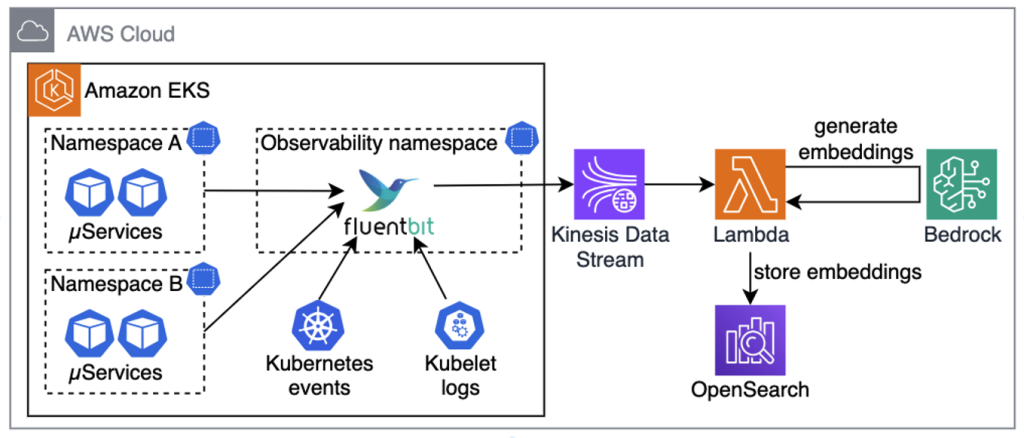
Architecting conversational observability for cloud applications
In this post, we walk through building a generative AI–powered troubleshooting assistant for Kubernetes. The goal is to give engineers a faster, self-service way to diagnose and resolve cluster issues, cut down Mean Time to Recovery (MTTR), and reduce the cycles experts spend finding the root cause of issues in complex distributed systems.

How BASF’s Agriculture Solutions drives traceability and climate action by tokenizing cotton value chains using Amazon Managed Blockchain
BASF Agricultural Solutions combines innovative products and digital tools with practical farmer knowledge. This post explores how Amazon Managed Blockchain can drive a positive change in the agricultural industry by tokenizing food and cotton value chains for traceability, climate action, and circularity.

She architects: Bringing unique perspectives to innovative solutions at AWS
Have you ever wondered what it is really like to be a woman in tech at one of the world’s leading cloud companies? Or maybe you are curious about how diverse perspectives drive innovation beyond the buzzwords? Today, we are providing an insider’s perspective on the role of a solutions architect (SA) at Amazon Web Services (AWS). However, this is not a typical corporate success story. We are three women who have navigated challenges, celebrated wins, and found our unique paths in the world of cloud architecture, and we want to share our real stories with you.