AWS Architecture Blog
Category: AWS Fargate

How Mapfre Insurance modernized fraud claims with Amazon EMR Serverless
Insurance fraud remains a significant challenge for the insurance industry because fraudulent claims can increase loss costs, reduce trust, and consume investigation capacity that could otherwise be focused on serving customers. Traditional fraud detection approaches typically rely on rules-based controls, manual investigation triggers, historical claim patterns, and structured-data-only analysis. These approaches are useful for known […]

PACIFIC enables multi-tenant, sovereign product carbon footprint exchange on the Catena-X data space using AWS
This post explores how PACIFIC enables multi-tenant, sovereign PCF exchange on the Catena-X data space using Amazon Elastic Container Service (Amazon ECS) on AWS Fargate, Amazon Cognito, and AWS Identity and Access Management (IAM) to deliver measurable environmental impact and competitive advantage in a carbon-conscious marketplace.

How BASF’s Agriculture Solutions drives traceability and climate action by tokenizing cotton value chains using Amazon Managed Blockchain
BASF Agricultural Solutions combines innovative products and digital tools with practical farmer knowledge. This post explores how Amazon Managed Blockchain can drive a positive change in the agricultural industry by tokenizing food and cotton value chains for traceability, climate action, and circularity.
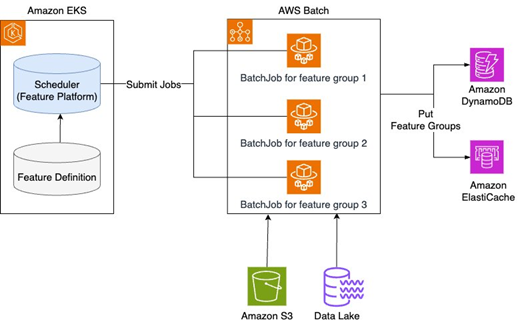
How Karrot built a feature platform on AWS, Part 2: Feature ingestion
This two-part series shows how Karrot developed a new feature platform, which consists of three main components: feature serving, a stream ingestion pipeline, and a batch ingestion pipeline. This post covers the process of collecting features in real-time and batch ingestion into an online store, and the technical approaches for stable operation.

Physics on AWS: Optimizing wind turbine performance using OpenFAST in a digital twin
Wind energy plays a crucial role in global decarbonization efforts by generating emission-free power from an abundant resource. In 2022, wind energy produced 2100 terawatt-hours (TWh) globally, or over 7% of global electricity, with expectations to reach 7400 TWh by 2030. Despite its potential, several challenges must be addressed to help meet grid decarbonization targets. […]

ITS adopts microservices architecture for improved air travel search engine
Internet Travel Solutions, LLC (ITS) is a travel management company that develops and maintains smart products and services for the corporate, commercial, and cargo sectors. ITS streamlines travel bookings for companies of any size around the world. It provides an intuitive consumer site with an integrated view of your travel and expenses. ITS had been […]

Genomics workflows, Part 4: processing archival data
Genomics workflows analyze data at petabyte scale. After processing is complete, data is often archived in cold storage classes. In some cases, like studies on the association of DNA variants against larger datasets, archived data is needed for further processing. This means manually initiating the restoration of each archived object and monitoring the progress. Scientists […]

Genomics workflows, Part 3: automated workflow manager
Genomics workflows are high-performance computing workloads. Life-science research teams make use of various genomics workflows. With each invocation, they specify custom sets of data and processing steps, and translate them into commands. Furthermore, team members stay to monitor progress and troubleshoot errors, which can be cumbersome, non-differentiated, administrative work. In Part 3 of this series, […]

Accelerate deployments on AWS with effective governance
Amazon Web Services (AWS) users ask how to accelerate their teams’ deployments on AWS while maintaining compliance with security controls. In this blog post, we describe common governance models introduced in mature organizations to manage their teams’ AWS deployments. These models are best used to increase the maturity of your cloud infrastructure deployments. Governance models […]

Let’s Architect! Using open-source technologies on AWS
With open-source technology, authors make software available to the public, who can view, use, or change it and add new features or support new capabilities. Open-source technology promotes collaboration across different teams, organizations, and people because the process often includes different perspectives and ideas, which typically results a stronger solution. It can be difficult to […]