AWS Lambda
Serverless compute for every workload
AWS Lambda today
Invocations / Month
Server to Manage
One service. Multiple ways to run. Scales with your workload.
What can you build with AWS Lambda?
Build and scale any application without managing infrastructure.
Web applications and server-side rendering
How do you deploy full-stack web apps globally with consistent performance and no infrastructure to manage?
Run your Express, Hono, or any Node.js HTTP server on Lambda Web Functions with no code changes. With active CPU billing, you pay for compute you actually use, not for the time your code spends waiting on I/O. Deploy to the regions you choose with a single command. A multi-region endpoint routes each request to the nearest region for fast, consistent responses, while multi-concurrency keeps requests on warm execution environments under load.
Event-driven applications
How do you build applications that scale automatically in response to events?
Connect to 220+ AWS services and respond to events automatically. An object lands in Amazon S3, a record hits Amazon DynamoDB, an API call comes in. Lambda Functions handle the scaling, you handle the logic. Pay only for what runs.
API backends and microservices
How do you run REST and GraphQL APIs on serverless without cold-start penalties or idle billing?
Build API backends with Express, Hono, or Fastify and deploy them to Lambda Web Functions with one command. Multi-concurrency handles bursty traffic across warm execution environments, reducing cold starts. Active CPU billing charges only for compute time, not wall-clock duration, cutting costs for I/O-heavy workloads waiting on databases or downstream APIs.
Isolated code execution
How do you build dedicated isolation for every tenant, user, and session?
Run untrusted or third-party code with VM-level isolation. No shared kernel, no shared memory, no shared state between tenants. Three levels of isolation, to per-tenant isolation to full MicroVM environments, so you pick the boundary that fits your threat model.
AI agent orchestration and durable workflows
How do you run multi-step applications and agentic workflows that last hours?
Build multi-step, long-running workflows that can pause, wait for signals, retry on failure, and run for hours. Lambda durable functions gives you the control flow primitives (branching, parallelism, timeouts) without bolting on a separate orchestrator. Works for agentic AI loops, human approval chains, and saga patterns alike.
Real-time data processing
How do you process streaming and batch data at any scale?
Process streams, transform records, and fan out to downstream systems as data arrives. Lambda Functions sits natively on Amazon Kinesis, Apache Kafka, Amazon SQS, and Amazon DynamoDB Streams, so you get sub-second processing without provisioning or tuning throughput. For sustained, high-throughput pipelines, Lambda Managed Instances provide dedicated capacity with predictable latency.
Data analytics, notebooks, and interactive query platforms
How do you give every analyst their own isolated compute environment?
Preserve packages, computed results, and execution context across sessions, with no resets and no re-computation. Lambda MicroVMs launch and resume rapidly with per-tenant isolation, retain state across sessions, and pause automatically when idle so you only pay for active use.
Using a coding agent?
Who’s running on Lambda at scale?
Frequently asked questions
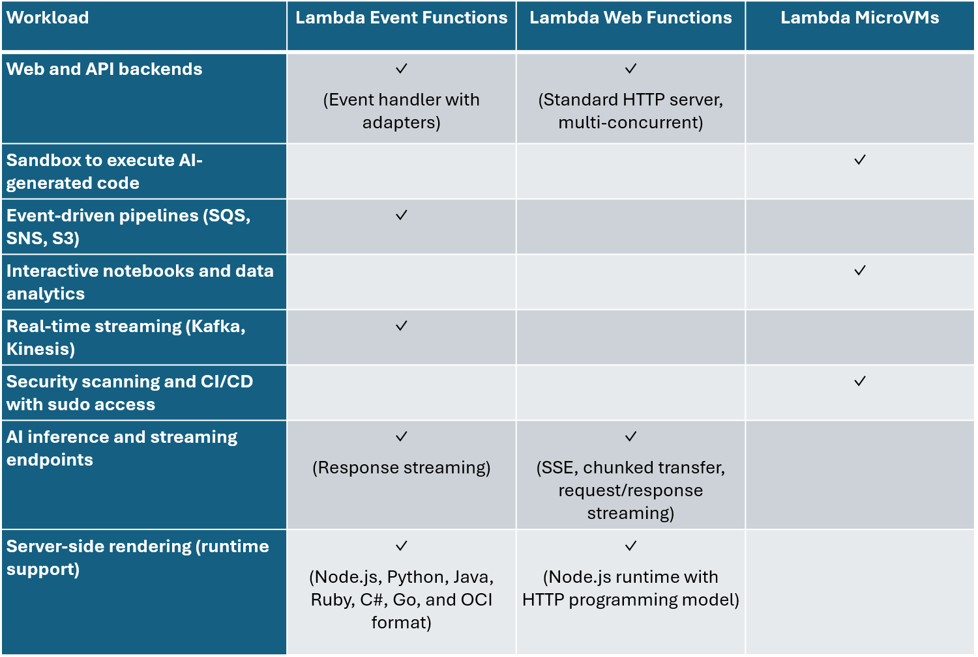
How do I choose between Lambda Event Functions, Lambda Web Functions, and Lambda MicroVMs?
AWS Lambda offers three form factors: Lambda Event Functions, Lambda Web Functions, and Lambda MicroVMs. They share the same serverless foundation: you don't manage servers, you pay only for what you use, and Lambda manages networking and isolation.. Choose based on your workload's isolation, state, and lifecycle needs.
Use Event Functions for discrete events from sources like SQS or Kafka, and for compute-intensive processing with Lambda Managed Instances. Use Web Functions when you want to run standard HTTP frameworks natively without adapters. Active compute billing is especially beneficial when your workload spends significant time waiting on databases, APIs, or network calls. Within Functions, let the programming and billing model guide you.
Choose MicroVMs when you need control over the execution environment itself, such as lifecycle management, state retention across sessions, or VM-level isolation for untrusted code. The deciding question is whether you want to manage only the code inside a sandbox and let Lambda manage the sandbox, or manage the sandbox lifecycle yourself. The following table shows the full comparison.
When should I use Lambda Managed Instances?
Lambda runs your Event Functions on fully managed infrastructure by default, with automatic scaling and pay-per-use pricing. Lambda Managed Instances give you dedicated EC2-backed capacity with built-in routing, load balancing, and multi-concurrency. Best for compute-intensive workloads like large-scale data processing, media transcoding, and scientific simulations. Up to 32 GB memory and 16 vCPUs, with no operational overhead.
Lambda Managed Instances also support a 90-minute function timeout for asynchronous and event source mapping (ESM) invocations, a 6x increase from the previous 15-minute limit. You can now run data processing, media transcoding, financial calculations, AI inference, and batch workloads on Lambda for jobs that require longer continuous execution, without re-architecting your applications.


Did you find what you were looking for today?
Let us know so we can improve the quality of the content on our pages