AWS for Industries
Life Sciences Agents in Production: Early Research
This blog is the first installment of an agentic AI in production series, focused on sharing learnings, customer examples, and AWS offerings for agentic AI across the value chain.
The life sciences industry is at an inflection point as organizations seek to advance beyond broad AI experimentation to strategic adoption of agentic AI in production. The evolution from extensive POCs to targeted investments in bringing agents into production is surfacing new challenges.
On the technical front, many life sciences organizations are discovering that their POCs require substantial re-engineering to address critical production requirements—including data integrations, security and compliance considerations, and scalability demands, particularly in early-stage research environments. Simultaneously, identifying the top use cases to invest in to demonstrate ROI presents its own complexities, as organizations navigate intensifying pricing pressures and accelerating time-to-market demands in an increasingly competitive landscape.
Investing in agentic AI accelerators for life sciences
AWS’ extensive experience helping life sciences companies—ranging from early-stage biotechs to 19 out of the top 20 pharma organizations — deploy agentic AI in production has revealed distinct patterns in successful use cases and implementation strategies. Drawing from these insights and working closely with industry leaders, our specialized life sciences team has invested in the development of tools that remove implementation barriers and fast-track the journey from pilot to production.

For example, this year at our annual symposium we introduced sample agents for healthcare and life sciences on AWS, available through an open-source toolkit. This toolkit helps developers quickly build agents for common workflows across drug research, clinical trials, and commercialization with growing catalog of starter agents, and supervisor agents that can complete multi-agent workflows. It also includes a developer-facing UI component that can be used to securely assemble, test, and demonstrate multi-agent workflows within the organization’s VPC, helping to bridge the vision gap between IT and functional leads when designing agentic solutions.
Since May, AWS has continued to dive deeper with our customers to develop new ways to accelerate the agentic development cycle, helping our customers move into production faster. Now, we are expanding our existing investment with a catalog of agent accelerators.
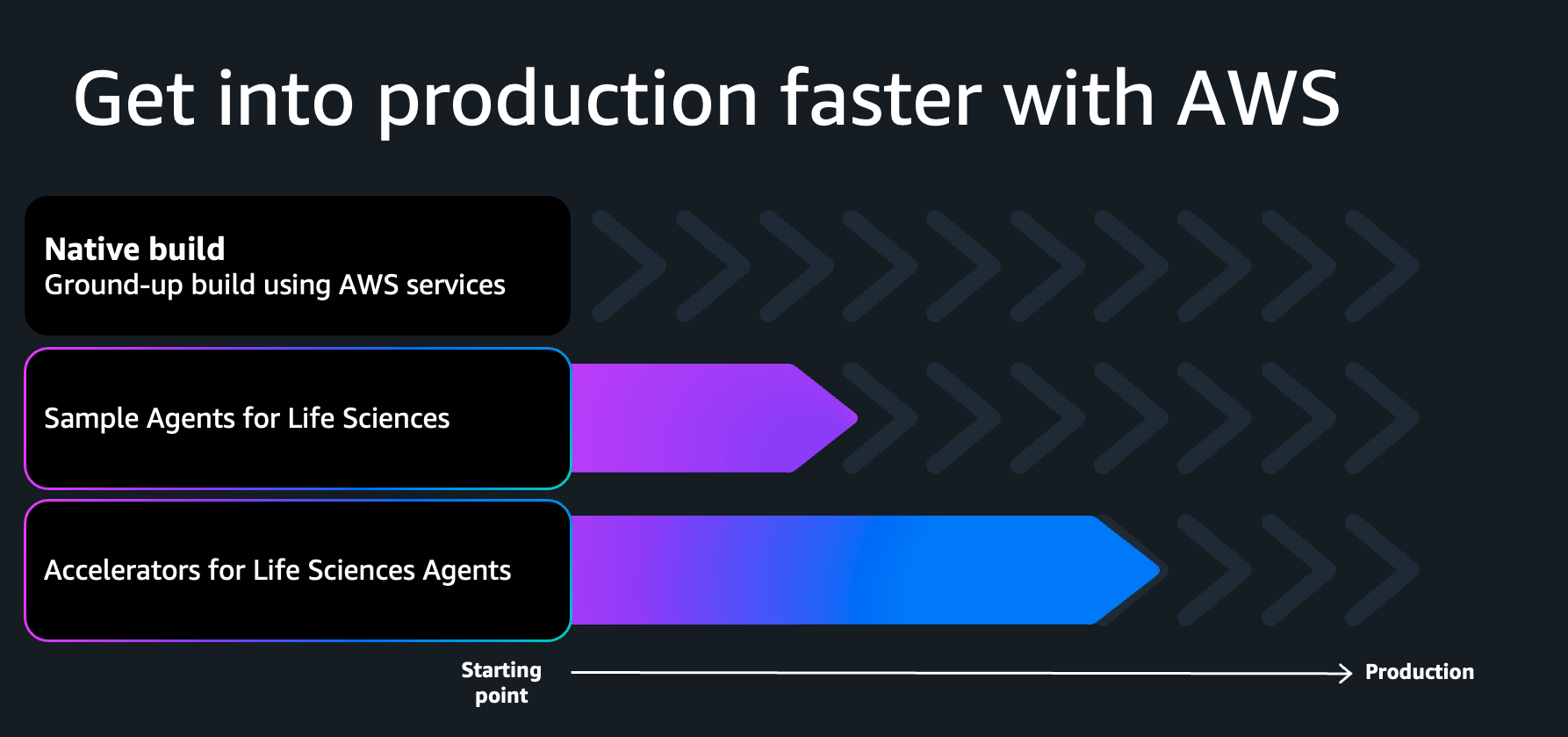
Where sample agents are designed to help developers start building faster, our accelerators are purpose-built agents that can readily be integrated and customized within your existing environment. Based on successful customer deployments, our growing catalog of accelerators focus on the top ROI use cases ranging from target identification to real-world data, to supporting 340B programs.
Accelerators are built for production scale and address foundational needs such as security best practices, network and service configuration, architectural design, and blueprinting — allowing our customers to focus their time and resources on the things that are differentiated to their business, such as integrating historical and proprietary data, preferred bioinformatics pipelines, and vendor systems. AWS ProServ and AWS Partners are available for customization and integration support.
For more information and to request a demonstration, please visit here.
As we head into AWS re:Invent 2025, we’re excited to showcase our sample agents, accelerators, and AI offerings in action — spanning from early research to real-world evidence, to market access.
Now, let’s dive deeper into early research, focusing on how our customers are using generative and agentic AI for biomedical research and lab automation.
Accelerating ingestion and synthesis using Agents
Biomedical research is a prime area that is recognizing significant and impactful value from agentic AI. Biomedical researchers spend significant amounts of time manually processing massive volumes of scattered information. With PubMed alone adding approximately 1.5 million papers annually, researchers can only read a small fraction while also navigating public repositories, specialized databases, and internal data repositories. This leaves less time for the evidence-based research that drives innovation.
Through close collaboration with leading pharmaceutical and biotechnology organizations, we’ve identified critical workflow challenges facing early asset R&D scientists. These researchers needed a solution that could:
- Unify fragmented knowledge sources across PubMed scientific literature, public repositories, specialized databases, and internal data repositories
- Maintain scientific rigor by providing cited summaries and traceable sources to preserve research integrity
- Democratize computational tools for bench scientists without requiring specialized data engineering skills

For those visiting re:Invent, join us at the Life Sciences Industry Pavilion on the expo floor, we will be showcasing our TargetID Agent. This demonstration highlights how agentic AI can transform early-stage drug discovery by rapidly analyzing and synthesizing vast amounts of complex biological data. This data includes scientific literature from PubMed, multi-omics data, biological pathways, and real-world evidence.
By rapidly processing and unifying fragmented knowledge into a centralized location, the agent reduces research timelines—expediting the delivery of novel drugs to market. This approach enables early research scientists to be subject matter experts instead of spending time on manual data integration. They can then synthesize information faster and accelerate innovation.
Our Accelerator for TargetID Agents is available now. To request access, please contact us.
For developers seeking guidance and examples for developing a TargetID agent, we also have sample agents available on our toolkit. You can read more about agents and how Genentech leverages generative AI to get lifesaving medicines to patients faster.
Democratizing lab automation with agentic workflows
Across the Life Sciences industry, organizations — including Bayer AG, Natera, Foundation Medicine, Resilience, and BigHat Biosciences — have built digitally connected labs on AWS to modernize scientific operations, increase automation, and unify data across research environments. Now, with agentic AI, we’re seeing a new wave of lab automation where agents work behind the scenes to help plan protocols, automate scripting tasks, and generate insights.
At re:Invent we will also be showcasing our agentic AI-powered lab-in-the-loop for accelerating cancer research. The demonstration illustrates how research teams can quickly explore the breast cancer therapeutic landscape, identify potential drug candidates, and iterate rapidly across design, execution, and analysis.
This workflow reflects a biopharmaceutical lead optimization process, structured around the Design–Make–Test–Analyze (DMTA) cycle. Molecules are designed and optimized in silico, prepared and executed in the wet lab, and then evaluated through high-quality experimental data that informs the next design iteration. This continuous loop drives faster convergence on high-quality leads for downstream development.
You’ll see three major stages in the demo:
- AI-guided drug design: Specialized generative and predictive models design and optimize candidate molecules for the selected target. The biological foundation models evaluate properties such as potency, selectivity, ADME, and safety, reducing the number of low-probability molecules entering the lab—saving both time and resources.
- Wet-lab planning and execution: AI agents generate experimental protocols, prepare equipment scripted instructions, and coordinate multi-step tasks across connected lab systems. This includes reagent preparation, instrument scheduling, and capturing metadata required for downstream analysis. Experiments are executed in the wet lab, and data is collected through standardized ingestion pipelines.
- Data analysis and model feedback: Captured experimental data is normalized, stored, and cataloged using AWS data services. AI agents interpret results, recommend the best statistical package to use for analysis, compare predicted versus observed outcomes, and refine models to improve future design iterations. This creates a tighter, faster loop between experiment and insight.
AWS is committed to investing and expanding capabilities that make it quicker to define, execute, and share multi-step lab tasks, without requiring specialized automation engineering skills. To get started on your lab automation journey, request a demonstration today or contact an AWS Representative for guidance and which accelerators are the best for your organization’s needs.
Conclusion
2025 has been a year of unparalleled growth at the intersection of AI and the life sciences. We’ve seen companies including Novo Nordisk, AstraZeneca, and Peptone redefine what’s possible with agentic AI, delivering tangible results at-scale.
As we look to 2026, we look forward to deepening our investments in developing new and expanded tools to help our life sciences customers get the most from agentic AI. And if you’re already planning your 2026 calendar, make sure to register and save the date for our the annual AWS Life Sciences Symposium 2026.
Further reading
- Request access to AWS’s accelerators for life sciences
- Sample Agents for Healthcare and Life Sciences on AWS
- Accelerating genomics variant interpretation with AWS HealthOmics and Amazon Bedrock AgentCore
- Build a biomedical research agent with Biomni tools and Amazon Bedrock AgentCore Gateway
- Guidance for Digital Connected Lab on AWS
- Integrate scientific data management and analytics with the next generation of Amazon SageMaker