AWS Database Blog
Category: MySQL compatible

Migrate Cloud SQL for MySQL to Amazon Aurora and Amazon RDS for MySQL Using AWS DMS
In this post, we demonstrate how to migrate from Cloud SQL for MySQL 8+ to Amazon RDS for MySQL 8+ or Amazon Aurora MySQL–Compatible using AWS DMS over an AWS Site-to-Site VPN. We cover preparing the source and target environments, exemplifying cross-cloud connectivity, and setting up DMS tasks.
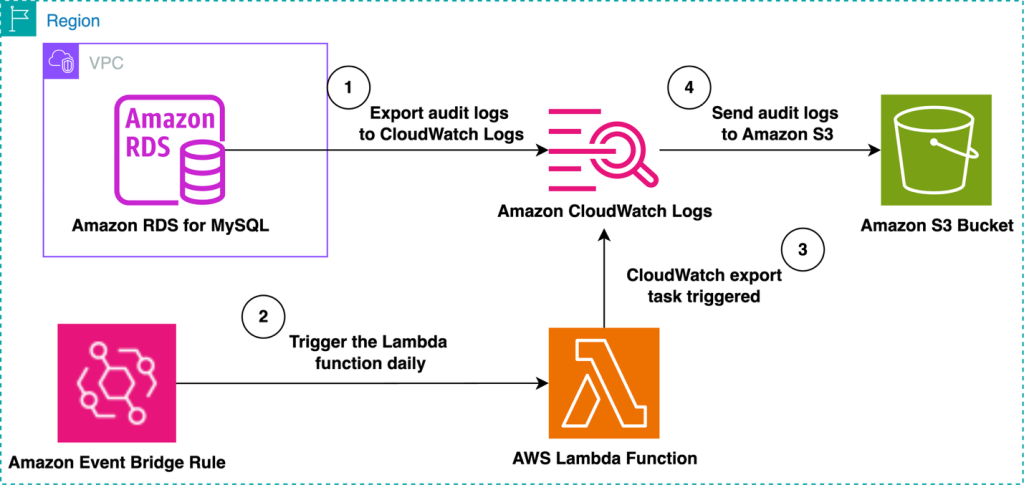
Automate the export of Amazon RDS for MySQL or Amazon Aurora MySQL audit logs to Amazon S3 with batching or near real-time processing
Amazon RDS for MySQL and Amazon Aurora MySQL provide built-in audit logging capabilities, but customers might need to export and store these logs for long-term retention and analysis. Amazon S3 offers an ideal destination, providing durability, cost-effectiveness, and integration with various analytics tools. In this post, we explore two approaches for exporting MySQL audit logs to Amazon S3: either using batching with a native export to Amazon S3 or processing logs in real time with Amazon Data Firehose.
Monitoring multithreaded replication in Amazon RDS for MySQL, Amazon RDS for MariaDB, and Aurora MySQL
In this post, we discuss methods to effectively monitor parallel replication performance and tune its related parameters for Amazon Aurora MySQL and Amazon Relational Database Service for MySQL and MariaDB.
Overview and best practices of multithreaded replication in Amazon RDS for MySQL, Amazon RDS for MariaDB, and Amazon Aurora MySQL
In this first post, we dive into the world of MySQL replication, with a special focus on parallel replication techniques. We start with a quick overview of how MySQL replication works, then explore the intricacies of multithreaded replication. We discuss key configuration options and best practices for optimization.
Amazon Aurora MySQL zero-ETL integration with Amazon SageMaker Lakehouse
In this post, we explore how zero-ETL integration works, the key benefits it delivers for data-driven teams, and how it aligns with the broader zero-ETL strategy in AWS services. You’ll learn how this integration can enhance your data workflows, whether you’re building predictive models, entering interactive SQL queries, or visualizing business trends. By eliminating traditional extract, transform, and load (ETL) processes, this solution enables real-time intelligence securely and at scale to help you make faster, data-driven decisions.
Dynamic view-based data masking in Amazon RDS and Amazon Aurora MySQL
Data masking is an important technique in cybersecurity, allowing organizations to safeguard personally identifiable information (PII) and other confidential data, while maintaining its utility for development, testing, and analytics purposes. Data masking involves replacing original sensitive data with false, yet realistic information. This process helps ensure that the masked version preserves the format and characteristics […]
Vibe code with AWS databases using Vercel v0
In this post, we explore how you can use Vercel’s v0 generative UI to build applications with a modern UI for AWS purpose-built databases such as Amazon Aurora, Amazon DynamoDB, Amazon Neptune, and Amazon ElastiCache.
Implement row-level security in Amazon Aurora MySQL and Amazon RDS for MySQL
Row-level security (RLS) is a security mechanism that enhances data protection in scalable applications by controlling access at the individual row level. It enables organizations to implement fine-grained access controls based on user attributes, so users can only view and modify data they’re authorized to access. This post focuses on implementing a cost-effective custom RLS solution using native MySQL features, making it suitable for a wide range of use cases without requiring additional software dependencies. This solution is applicable for both Amazon Relational Database Service (Amazon RDS) for MySQL and Amazon Aurora MySQL-Compatible Edition, providing flexibility for users of either service.
Streamline Amazon Aurora database operations at scale: Introducing the AWS Database Acceleration Toolkit
In this post, we introduce the AWS Database Acceleration Toolkit (DAT), an open source database accelerator. DAT is an infrastructure as code solution using Terraform to simplify and automate initial setup, provisioning, and on-going maintenance activities for Amazon Aurora.

Migrate very large databases to Amazon Aurora MySQL using MyDumper and MyLoader
In this post, we discuss how to migrate MySQL very large databases (VLDBs) from a self-managed MySQL database to Amazon Aurora MySQL-Compatible Edition using the MyDumper and MyLoader tools.