AWS Compute Blog
Tag: Amazon EC2

Extending Amazon Linux 2 with EPEL and Let’s Encrypt
This post courtesy of Jeff Levine Solutions Architect for Amazon Web Services Amazon Linux 2 is the next generation of Amazon Linux, a Linux server operating system from Amazon Web Services (AWS). Amazon Linux 2 offers a high-performance Linux environment suitable for organizations of all sizes. It supports applications ranging from small websites to enterprise-class, […]

New Amazon EC2 Spot pricing model: Simplified purchasing without bidding and fewer interruptions
Contributed by Deepthi Chelupati and Roshni Pary Amazon EC2 Spot Instances offer spare compute capacity in the AWS Cloud at steep discounts. Customers—including Yelp, NASA JPL, FINRA, and Autodesk—use Spot Instances to reduce costs and get faster results. Spot Instances provide acceleration, scale, and deep cost savings to big data workloads, containerized applications such as […]

Accelerating Precision Medicine at Scale
This post courtesy of Aaron Friedman, Healthcare and Life Sciences Partner Solutions Architect, AWS and Angel Pizarro, Genomics and Life Sciences Senior Solutions Architect, AWS Precision medicine is tailored to individuals based on quantitative signatures, including genomics, lifestyle, and environment. It is often considered to be the driving force behind the next wave of human […]

Bringing Datacenter-Scale Hardware-Software Co-design to the Cloud with FireSim and Amazon EC2 F1 Instances
The recent addition of Xilinx FPGAs to AWS Cloud compute offerings is one way that AWS is enabling global growth in the areas of advanced analytics, deep learning and AI. The customized F1 servers use pooled accelerators, enabling interconnectivity of up to 8 FPGAs, each one including 64 GiB DDR4 ECC protected memory, with a […]
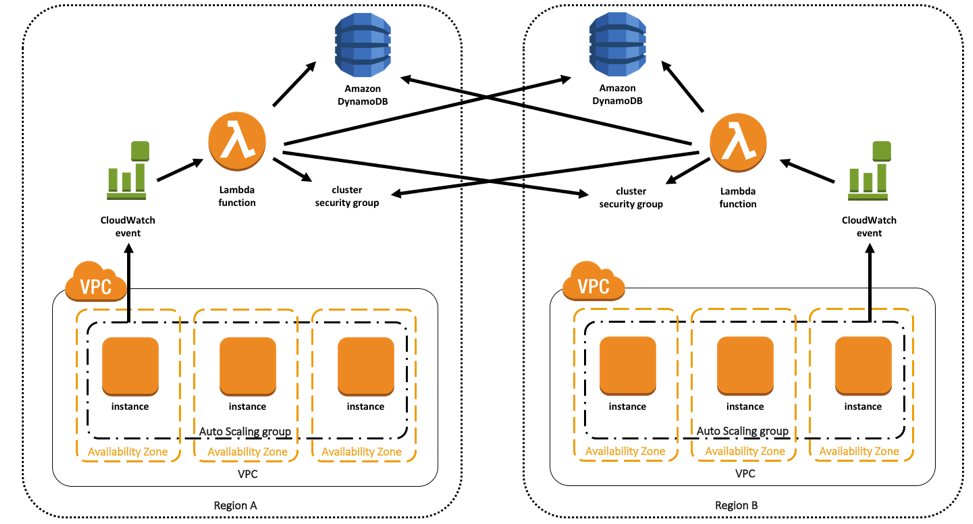
Automating Security Group Updates with AWS Lambda
Customers often use public endpoints to perform cross-region replication or other application layer communication to remote regions. But a common problem is how do you protect these endpoints? It can be tempting to open up the security groups to the world due to the complexity of keeping security groups in sync across regions with a […]