AWS Compute Blog

Running Cost-effective queue workers with Amazon SQS and Amazon EC2 Spot Instances
This post is contributed by Ran Sheinberg | Sr. Solutions Architect, EC2 Spot & Chad Schmutzer | Principal Developer Advocate, EC2 Spot | Twitter: @schmutze Introduction Amazon Simple Queue Service (SQS) is used by customers to run decoupled workloads in the AWS Cloud as a best practice, in order to increase their applications’ resilience. You […]

New AWS Lambda controls for stream processing and asynchronous invocations
Today AWS Lambda is introducing new controls for asynchronous and stream processing invocations. These new features allow you to customize responses to Lambda function errors and build more resilient event-driven and stream-processing applications. Stream processing function invocations When processing data from event sources such as Amazon Kinesis Data Streams, and Amazon DynamoDB Streams, Lambda reads […]

New AWS Lambda scaling controls for Kinesis and DynamoDB event sources
AWS Lambda is introducing a new scaling parameter for Amazon Kinesis Data Streams and Amazon DynamoDB Streams event sources. Parallelization Factor can be set to increase concurrent Lambda invocations for each shard, which by default is 1. This allows for faster stream processing without the need to over-scale the number of shards, while still guaranteeing […]

Migrating from IBM MQ to Amazon MQ using a phased approach
This post is contributed by Mithun Mallick, Solutions Architect and Christian Mueller, Solutions Architect Message-oriented middleware (MOM), or message brokers, are the backbone that integrates business critical applications in many industries. MOMs are used to integrate systems like inventory management, payment systems, and CRM systems. They are also used to orchestrate order-processing workflows across multiple systems, […]

Application integration patterns for microservices: Fan-out strategies
This post is courtesy of Dirk Fröhner, Sr. Solutions Architect The first blog in this series introduced asynchronous messaging for building loosely coupled systems that can scale, operate, and evolve individually. It considered messaging as a communications model for microservices architectures. This post covers concrete architectural considerations, focusing on the messaging architecture. Part 3 covers running […]
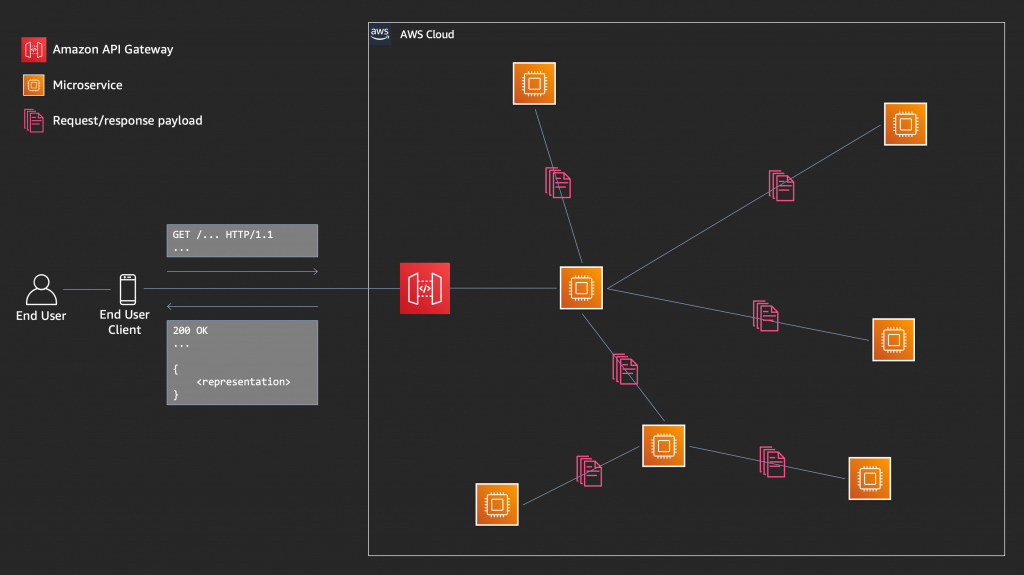
Understanding asynchronous messaging for microservices
This post is courtesy of Dirk Fröhner, Sr. Solutions Architect One of the implications of applying the microservices architectural style is that much communication between components happens over the network. After all, your microservices landscape is a distributed system. To achieve the promises of microservices, such as being able to individually scale, operate, and evolve each service, this […]

New for AWS Lambda – SQS FIFO as an event source
AWS Lambda first announced support for Amazon SQS standard queues as an event source in April 2018. This allows builders to develop serverless applications using queues to directly invoke Lambda functions. Today, we have expanded this feature to include SQS FIFO queues. This makes it easier to create serverless applications using queues where the order […]

Automating Zendesk With Amazon EventBridge and AWS Step Functions
In July 2019, AWS launched Amazon EventBridge, a serverless event bus that offers third-party software as a service (SaaS) integration capabilities. This service allows applications and AWS services to integrate with each other in near-real time via an event bus. Amazon EventBridge launched with a number of partner integrations, to enable you to quickly connect […]

Java 11 runtime now available in AWS Lambda
We are excited to announce that you can now develop your AWS Lambda functions using the Java 11 runtime. Start using this runtime today by specifying a runtime parameter value of java11 when creating or updating your Lambda functions. The Java 11 runtime does not introduce any changes in Lambda’s programming model, such as handler […]
Node.js 12.x runtime now available in AWS Lambda
We are excited to announce that you can now develop AWS Lambda functions using the Node.js 12.x runtime, which is the current Long Term Support (LTS) version of Node.js. Start using this new version today by specifying a runtime parameter value of nodejs12.x when creating or updating functions. Language Updates Here is a quick primer that highlights […]