AWS Compute Blog

Migrating your Amazon ECS deployment to the new ARN and resource ID format
Update – August 21, 2020 – Added a section with the latest timeline. Starting today you can opt in to a new Amazon Resource Name (ARN) and resource ID format for Amazon ECS tasks, container instances, and services. The new format enables the enhanced ability to tag resources in your cluster, as well as tracking […]

Encrypting messages published to Amazon SNS with AWS KMS
Post by Otavio Ferreira, Software Development Manager, Amazon SNS — Amazon Simple Notification Service (Amazon SNS) is a fully managed pub/sub messaging service for decoupling event-driven microservices, distributed systems, and serverless applications. To address the requirements of highly critical workloads, Amazon SNS provides message encryption in transit, based on Amazon Trust Services (ATS) certificates, as well as message encryption at rest, using AWS Key Management Service (AWS KMS) keys.

Windows @ AWS re:Invent 2018
This post is courtesy of Rodney Bozo, Senior Solutions Architect – Microsoft Technologies – AWS Windows has been a first-class citizen at AWS for over a decade. More enterprises run Windows workloads today on AWS than any other cloud—according to IDC, it’s over 57%, 2X than the next provider. Over this period, we’ve worked with […]
Support for multi-value parameters in Amazon API Gateway
This post is courtesy of Akash Jain, Partner Solutions Architect – AWS The new multi-value parameter support feature for Amazon API Gateway allows you to pass multiple values for the same key in the header and query string as part of your API request. It also allows you to pass multi-value headers in the API response to implement […]
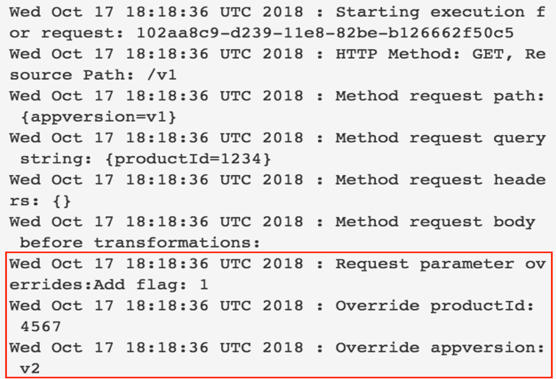
Overriding request/response parameters and response status in Amazon API Gateway
This post is courtesy of Akash Jain, Partner Solutions Architect – AWS APIs are driving modern architectures. Many customers are moving their traditional architecture to service-oriented or microservices-based architectures. As part of this transition, you may face a few complex situations. For example, a backend API returns an HTTP status code of 2XX that must […]

Scanning Docker Images for Vulnerabilities using Clair, Amazon ECS, ECR, and AWS CodePipeline
Post by Vikrama Adethyaa, Solution Architect and Tiffany Jernigan, Developer Advocate Update – July 26, 2021 – While this post remains accurate, we want to make it clear that we did announce built in image scanning in Amazon ECR in October 2019. The built in integration provides a simpler solution than what is in this post. […]
Amazon ElastiCache performance boost with Amazon EC2 M5 and R5 instances
Contributed by Ruchita Arora, Sr. Product Manager, Allen Farris, Software Dev Engineer, and Itay Maoz, Sr. Software Engineering Manager Earlier this year, Amazon EC2 introduced two exciting new instance families, M5 and R5. These instances are based on the new AWS Nitro system, a combination of dedicated hardware and lightweight hypervisor that aims to deliver […]
Re-affirming Long-Term Support for Java in Amazon Linux
In light of Oracle’s recent announcement indicating an end to free long-term support for OpenJDK after January 2019, we re-affirm that the OpenJDK 8 and OpenJDK 11 Java runtimes in Amazon Linux 2 will continue to receive free long-term support from Amazon until at least June 30, 2023. We are collaborating and contributing in the […]
Deploying a Burstable and Event-driven HPC Cluster on AWS Using SLURM, Part 2
Contributed by Amr Ragab, HPC Application Consultant, AWS Professional Services In part 1 of this series, you deployed the base components to create the HPC cluster. This unique deployment stands up the SLURM headnode. For every job submitted to the queue, the headnode provisions the needed compute resources to run the job, based on job […]

ICYMI: Serverless Q3 2018
Welcome to the third edition of the AWS Serverless ICYMI (in case you missed it) quarterly recap. Every quarter, we share all of the most recent product launches, feature enhancements, blog posts, webinars, Twitch live streams, and other interesting things that you might have missed! If you didn’t see them, catch our Q1 ICYMI and […]