AWS Compute Blog
Category: Advanced (300)

Implementing Federation on Amazon MQ for RabbitMQ Private Brokers
Currently, the federation plugin on Amazon MQ for RabbitMQ connects to publicly available upstream brokers only. This post explains how to implement federation for Amazon MQ RabbitMQ Private Brokers using Network Load Balancers (NLB). The steps allow private brokers to communicate with each other to create a distributed system.

Powering hybrid workloads with Amazon API Gateway
Amazon API Gateway can provide a single-entry point for all incoming API requests for Hybrid Workloads. It provides a layer of abstraction between the API consumers and the backend services, allowing for centralized control. Routing all traffic through the API Gateway lets builders centrally enforce authentication, authorization, rate limiting, and other security features. This blog post describes how to configure API Gateway as an entry point to your on-premises resources.

Monitoring network traffic in AWS Lambda functions
In this post, you will learn methods for network monitoring in AWS Lambda functions and how to apply them to your scenarios.

Optimizing cold start performance of AWS Lambda using advanced priming strategies with SnapStart
Introduced at re:Invent 2022, SnapStart is a performance optimization that makes it easier to build highly responsive and scalable applications using AWS Lambda. The largest contributor to startup latency (often referred to as cold-start time) is the time spent initializing a function. This post discusses ‘Priming’, a technique to further optimize startup times for AWS Lambda functions built using Java and Spring Boot.
Maintaining spare capacity during host failures on AWS Outposts with dynamic monitoring
In this post, we review best practices for capacity management and fault tolerance with Outposts rack followed by an example of how the Outposts API can be used to build an automated monitoring and alerting system to highlight potential resiliency issues.

Streamlining trace sampling behavior for AWS Lambda functions with AWS X-Ray
This post explores the importance of distributed tracing for operating serverless applications and announces an important update to tracing behavior for AWS Lambda, which streamlines how trace context is handled in PassThrough mode. This blog post will demonstrate how this change gives you better control over how your Lambda functions handle tracing with AWS X-Ray through practical examples. Whether you’re building new applications or operating existing ones, this update helps you achieve more predictable and efficient tracing across your serverless applications built using Lambda.

Simplifying Amazon EC2 instance type flexibility with new attribute-based instance type selection features
This blog is written by Rajesh Kesaraju, Sr. Solution Architect, EC2-Flexible Compute and Peter Manastyrny, Sr. Product Manager, EC2. Today AWS is adding two new attributes for the attribute-based instance type selection (ABS) feature to make it even easier to create and manage instance type flexible configurations on Amazon EC2. The new network bandwidth attribute […]
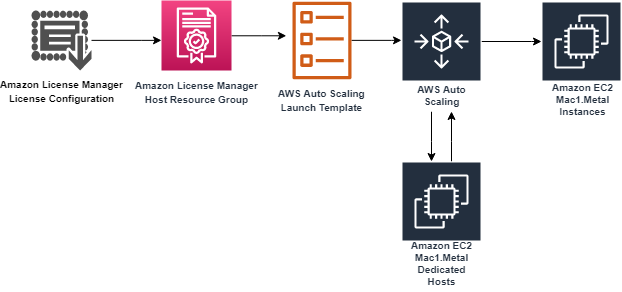
Implementing Auto Scaling for EC2 Mac Instances
Amazon Elastic Compute Cloud (Amazon EC2) is a web service that provides secure, resizable compute capacity in the cloud. The introduction of Amazon EC2 Mac now enables macOS based workloads to run in the AWS Cloud. These EC2 instances require Dedicated Hosts usage. EC2 integrates natively with Amazon CloudWatch to provide monitoring and observability capabilities. In order to best […]

Use Amazon EC2 for cost-efficient cloud gaming with pay-as-you-go pricing
July 2025c2: This post was reviewed for accuracy. Cloud gaming enables access to high-performance gaming without upfront hardware investment, using pay-as-you-go pricing instead. Cloud gaming platforms such as Amazon Luna are an entryway, but users are limited to the games available on the service. Furthermore, many users also prefer to own their games, or they […]

Cost Optimize your Jenkins CI/CD pipelines using EC2 Spot Instances
Author: Rajesh Kesaraju, Sr. Specialist Solution Architect, EC2 Spot Instances In this blog post, I go over using Amazon EC2 Spot Instances on continuous integration and continuous deployment (CI/CD) workloads, via the popular open-source automation server Jenkins. I also break down the steps required to adopt Spot Instances into your CI/CD pipelines for cost optimization purposes. In this blog, I explain […]