
Sold by: Pulumi
Deployed on AWS
Pulumi's modern infrastructure as code platform enables cloud engineering teams to build, deploy, and manage cloud applications and infrastructure using familiar languages, tools, and engineering practices. Pulumi works with JavaScript, TypeScript, Python, .NET, and Go on over 70 cloud platforms.
4.8
Overview
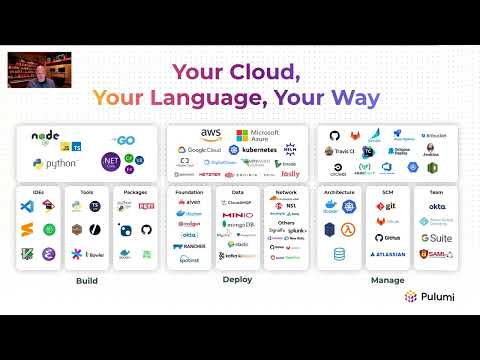
Pulumi helps engineering teams tame the cloud's complexity with modern infrastructure as code using the world's most popular programming languages including Python, JavaScript, TypeScript, Go, and .NET.
This allows developers to use a single workflow for delivering and securing infrastructure and applications on any cloud-public, private, or hybrid with over 70 integrated cloud providers.
Pulumi Enterprise Edition brings the power of Pulumi's cloud engineering platform to your entire organization for easier collaboration and management across teams.
Features include:
- State & secrets management
- CI/CD integrations like AWS Codepipeline and GitHub Actions
- Role-based access control (RBAC) with unlimited teams
- SAML/Single-sign-on
- Audit logs
For custom pricing, Business Critical features like policy as code, 24x7 support, self-hosted Pulumi, or private contracts, please contact hello+aws@pulumi.com
Highlights
- Learn how Pulumi can accelerate your AWS migration: https://aws.amazon.com/partners/success/skai-pulumi
- Want commitment discounts? Contact us at hello+aws@pulumi.com for a private offer
Get personalized pricing in minutes - New
If qualified, an express private offer gets you custom pricing and terms. Finalize your purchase in the AWS Marketplace console.
Details
Sold by
Delivery method
Deployed on AWS
Features and programs
Financing for AWS Marketplace purchases
AWS Marketplace now accepts line of credit payments through the PNC Vendor Finance program. This program is available to select AWS customers in the US, excluding NV, NC, ND, TN, & VT.

Pricing
Pricing is based on the duration and terms of your contract with the vendor, and additional usage. You pay upfront or in installments according to your contract terms with the vendor. This entitles you to a specified quantity of use for the contract duration. Usage-based pricing is in effect for overages or additional usage not covered in the contract. These charges are applied on top of the contract price. If you choose not to renew or replace your contract before the contract end date, access to your entitlements will expire.
Additional AWS infrastructure costs may apply. Use the AWS Pricing Calculator to estimate your infrastructure costs.
Dimension | Description | Cost/12 months |
|---|---|---|
Pulumi Enterprise | 2500 Resources, 15 team members w/ 12x5 support (21.9M Pulumi Credits) | $32,850.00 |
Dimension | Cost/unit |
|---|---|
100K Additional Pulumi Credits (1 Credit = 1 Resource/Hour) | $300.00 |
Vendor refund policy
All fees are non-cancellable and non-refundable except as required by law.
Custom pricing options
Request a private offer to receive a custom quote.

Legal
Vendor terms and conditions
Upon subscribing to this product, you must acknowledge and agree to the terms and conditions outlined in the vendor's End User License Agreement (EULA) .
Content disclaimer
Vendors are responsible for their product descriptions and other product content. AWS does not warrant that vendors' product descriptions or other product content are accurate, complete, reliable, current, or error-free.
Delivery details
Software as a Service (SaaS)
SaaS delivers cloud-based software applications directly to customers over the internet. You can access these applications through a subscription model. You will pay recurring monthly usage fees through your AWS bill, while AWS handles deployment and infrastructure management, ensuring scalability, reliability, and seamless integration with other AWS services.
Support
Vendor support
Email support is offered Monday - Friday during normal business hours. To open a support ticket or view service status, please visit
AWS infrastructure support
AWS Support is a one-on-one, fast-response support channel that is staffed 24x7x365 with experienced and technical support engineers. The service helps customers of all sizes and technical abilities to successfully utilize the products and features provided by Amazon Web Services.
Updated weekly
By Pulumi

By Spacelift Inc.

Top
10
In Testing, Infrastructure as Code
Top
10
In Software Development, Infrastructure as Code, Continuous Integration and Continuous Delivery
Top
50
In High Performance Computing
Sentiment is AI generated from actual customer reviews on AWS and G2
Functionality
Ease of use
Customer service
Cost effectiveness
Positive reviews
Mixed reviews
Negative reviews
AI generated from product descriptions
State and Secrets Management
Centralized management of infrastructure state and secrets across deployments
CI/CD Integration
Integration with CI/CD platforms including AWS CodePipeline and GitHub Actions
Role-Based Access Control
Role-based access control with support for unlimited teams and granular permission management
Single Sign-On Authentication
SAML and single sign-on authentication capabilities for enterprise identity management
Audit Logging
Comprehensive audit logs for tracking and monitoring infrastructure changes and user activities
Infrastructure as Code Orchestration
Supports orchestration of multiple IaC tools including Terraform, OpenTofu, CloudFormation, Pulumi, and Ansible for unified infrastructure provisioning and configuration management.
Automated Drift Detection and Remediation
Automatically detects infrastructure drift and restores resources to their expected state through drift remediation capabilities.
AI-Powered Natural Language Interface
Provides an AI infrastructure assistant that enables understanding, designing, deploying, and governing infrastructure using natural language queries and commands.
Policy-Based Governance Framework
Implements governance controls with custom policy definitions, Golden Paths, integration with third-party security vulnerability scanning tools, and best-practice policy templates.
Multi-Tool Workflow Integration
Combines infrastructure provisioning, configuration management, container orchestration, and governance policies into integrated workflows with dependency management and shareable outputs.
AWS Service Integration
Full Ansible collection for AWS with native integrations including EC2, CloudFormation, VPC, ALB, AMI, Security Groups, key pairs, EFS, EBS, S3, RDS, Lambda, and AWS Secrets Manager
Multi-Environment Deployment
Capability to deploy and run on AWS cloud with extension to private clouds, on-premise datacenters, edge locations, and hybrid cloud environments
Workflow Orchestration
End-to-end automation platform for configuring systems, deploying software, and orchestrating advanced workflows across enterprise infrastructure
OpenShift Compatibility
Installation support via operator on Red Hat OpenShift on AWS (ROSA) and OpenShift running directly on AWS infrastructure
Included RHEL Subscriptions
Includes up to 10 Red Hat Enterprise Linux subscriptions for deploying Ansible Automation Platform instances
Standard contract
No
No
Customer reviews
Aniruddha G.
Great product
Reviewed on May 13, 2024
Review provided by G2
What do you like best about the product?
Very easy to configure and manage. Works well in Github actions as well
What do you dislike about the product?
Documentation can be a bit daunting for new users and Pulumi AI hallucination can be a bit of a pain
What problems is the product solving and how is that benefiting you?
Automate and manage my cloud deployments
杰 .
Cool
Reviewed on Mar 13, 2024
Review provided by G2
What do you like best about the product?
Allow the TDDers to write automation tests, even IaC code can be tested!
What's more the secret as code is made possible and it's safer than SOPS. (It's harder to make mistakes than with SOPS).
What's more the secret as code is made possible and it's safer than SOPS. (It's harder to make mistakes than with SOPS).
What do you dislike about the product?
Cognitive load is somewhat higher than expected.
What problems is the product solving and how is that benefiting you?
Secret as code is hard. We used SOPS before, but sometimes, we made mistakes, such as forgetting to encrypt them before pushing them to the code repo.
The Pulumi helped us prevent that and forced us always to push the secret as encrypted.
Also it's hard to TDD the IaC code, with Pulumi, it's possible!
The Pulumi helped us prevent that and forced us always to push the secret as encrypted.
Also it's hard to TDD the IaC code, with Pulumi, it's possible!
Sebastian S.
Automation API connects Programming Languages with a Streamlined Interface for Multi-Cloud
Reviewed on Feb 22, 2024
Review provided by G2
What do you like best about the product?
- Multi Cloud Support
- Multi Language Support
- Automation API
- State Management
- Multi Language Support
- Automation API
- State Management
What do you dislike about the product?
- Recovery from erroneous states within the Automation API is not as effortless as using the CLI
What problems is the product solving and how is that benefiting you?
Using Cloud Automation inside of the Busines Logic of a SaaS using TypeScript
Haris A.
Amazing SDK. I just love it
Reviewed on Feb 20, 2024
Review provided by G2
What do you like best about the product?
Ease of use and writing code. It just makes things easy to deploy
What do you dislike about the product?
Little bit technical to understand but once you do it its easy
What problems is the product solving and how is that benefiting you?
It makes deployment easy
Matthieu V.
A new approach for Infra-As-Code, much more closer to "as-code" than yaml oriented tools
Reviewed on Jan 30, 2024
Review provided by G2
What do you like best about the product?
Pulumi is an awesome tool to easily manage Infra-as-code with a new approach more based on code than yaml like its competitors.
Being able to use my favorite langage to manage my infrastructure is really useful.
Onboarding to Pulumi is made easy thank to the complete documentation and a large community to answer any question
Being able to use my favorite langage to manage my infrastructure is really useful.
Onboarding to Pulumi is made easy thank to the complete documentation and a large community to answer any question
What do you dislike about the product?
What is currently not yet covered at 100% is that some SDKs are not available in all supported langages.
But thanks to the great community it's improving very fast
But thanks to the great community it's improving very fast
What problems is the product solving and how is that benefiting you?
Implementing Infra-as-code with a real "as-code" approach based on your favorite development langage rather than using yaml files.
It's really easier for dev team to onboard and work with Pulumi to manage their infrastructure
It's really easier for dev team to onboard and work with Pulumi to manage their infrastructure